MOEA Unites Over 22 Research Organizations to Accelerate AI Transformation
2026-10-29
The Ministry of Economic Affairs (MOEA) is accelerating AI transformation across Taiwan's R&D ecosystem. The Cross-Institute AI Transformation Accelerator Forum, hosted by the Industrial Technology Research Institute (ITRI), brought together more than 22 research organizations, including the Metal Industries Research & Development Centre (MIRDC), Taiwan Textile Research Institute (TTRI), Institute for Information Industry (III), and Automotive Research & Testing Center (ARTC).
ITRI, III, and Far EasTone Telecommunications Co., Ltd. (FET) shared practical experience in AI transformation from the perspectives of R&D organizations and industry. Through knowledge exchange and collaborative learning, the forum aims to accelerate AI adoption, encourage wider sharing of practical experience and resources, and enhance R&D and operational efficiency across research organizations.
MOEA Deputy Minister Ho Chin-Tsang said that the Ministry continues to advance major initiatives, including the Five Trusted Industry Sectors and Taiwan's Ten Major AI Infrastructure Projects, with strategic development spanning semiconductors, AI, next-generation communications, advanced computing, drones, and robotics. Meanwhile, MOEA is helping traditional industries enter high-tech supply chains by addressing business needs through diagnostic consulting, field assessments, and practical AI training programs to empower SMEs and accelerate their digital transformation.
"As research organizations play a vital role in bridging government policy and industry needs, MOEA is actively promoting collaboration among R&D institutes, with larger organizations helping smaller and medium-sized institutes leverage complementary expertise and R&D resources to strengthen interdisciplinary capabilities across Taiwan's research ecosystem," noted Ho.
Ho further stated that the Cross-Institute AI Transformation Accelerator marks an important starting point for deeper collaboration among research organizations. The initiative will turn individual organizations' experience with AI transformation into shared capabilities across the broader R&D ecosystem through three key approaches.
First, bring AI into industry to create value. By combining the technological expertise and extensive industry experience accumulated by research organizations, the initiative will help companies develop practical AI solutions for real-world applications.
Second, use AI to accelerate interdisciplinary integration. By leveraging the complementary strengths of different research organizations, the initiative will promote the integration of AI with semiconductors, communications, robotics, drones, biomedical technologies, manufacturing, and other fields to develop cross-disciplinary system solutions.
Third, build trusted and sustainable AI transformation capabilities. Research organizations will jointly build expertise and capabilities in data governance, talent development, cybersecurity, and trustworthy AI, accelerating transformation across the entire R&D ecosystem. Ho emphasized that the strength of Taiwan's research organizations is a driving force behind the advancement of Taiwan's industries.
With support from MOEA, collaboration among research organizations has already delivered significant results. In joint talent development, systems engineering workshops and executive training programs have been launched to bring together participants from different institutes, strengthening organizational management, interdisciplinary collaboration, and strategic thinking among R&D leaders and professionals.
In joint R&D innovation, participating organizations have worked together to explore future technology strategies and roadmaps. Nearly 50 sessions on medium- and long-term technology strategies and roadmaps have been held to date, creating new opportunities for interdisciplinary collaboration.
In resource sharing, participating institutes are linking technology platforms, industry intelligence, application environments, tools, and other resources to establish a collaborative network capable of jointly addressing complex challenges.
At the forum, ITRI shared its own AI transformation strategy and implementation experience. ITRI is advancing AI transformation in three strategic directions-trusted governance, efficiency enhancement, and value creation-supported by four foundational pillars: talent development, organizational culture, institutional governance, and computing platforms and resources. Together, these elements form a comprehensive AI transformation framework.
Going forward, ITRI will turn its transformation experience into replicable models that can help other research organizations and businesses accelerate their own AI transformation, ultimately drawing on these capabilities to develop services that support both industry and government.
The Cross-Institute AI Transformation Accelerator will continue to integrate resources and expand collective capabilities. Beginning with the sharing of best practices, the initiative will progress to trials of selected AI tools and then accelerate the replication and broader adoption of successful applications.
Its implementation is structured around three stages: Learn, Apply, and Create.
Learn focuses on strengthening AI capabilities and establishing platforms for knowledge exchange to accelerate AI capacity-building across research organizations.
Apply promotes joint trials of AI tools and encourages their practical adoption in organizational operations and R&D activities.
Create advances joint R&D innovation, technological collaboration, and industrial applications across research organizations, collectively enhancing the value generated through scientific and technological innovation.
Contacts
Contact Person: ITRI Ms. Chen Jou-An
Phone: +886-3-5916378
E-MAIL: annc@itri.org.tw
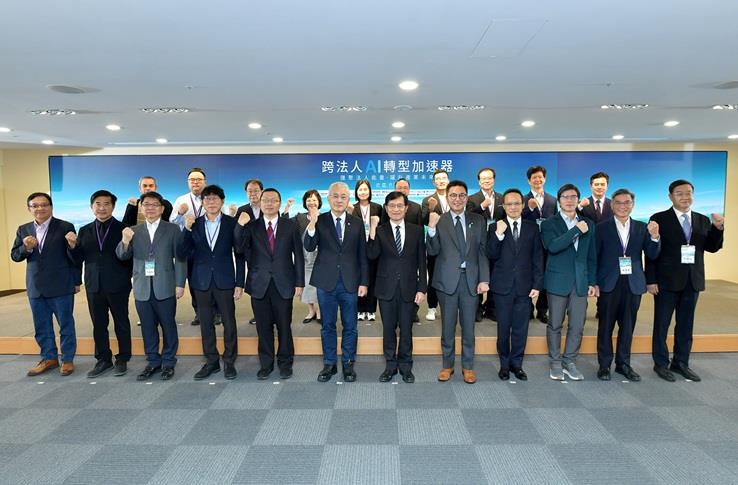
Source: Department of Industrial Technology