BIP advances smart governance with AI-based industrial pipeline risk identification and smart sewer networks to improve wastewater management efficiency.
2026-10-28
The Bureau of Industrial Parks (BIP) of the Ministry of Economic Affairs (MOEA) announced on October 30 that it continues to adopt artificial intelligence (AI), cloud-based big data analytics, and smart monitoring technologies to enhance industrial pipeline risk identification, early warning and emergency response capabilities, and wastewater management efficiency. For industrial pipeline safety, BIP has established a “Cloud-Based Industrial Pipeline Platform” that integrates basic information on seven pipeline corridors and 69 pipelines, along with more than one million records of spatial data, inspection histories, and related information, to strengthen AI-powered risk identification and early warning capabilities. For wastewater management, BIP introduced smart sewer networks at the Tucheng and Dajia Youth Industrial Park wastewater treatment plants as demonstration sites, reducing chemical consumption costs by more than 20%, cutting wastewater treatment electricity consumption by 29%, and reducing carbon emissions by approximately 7,000 kg of CO₂. Through these initiatives, BIP is progressively developing modern industrial parks that integrate safety and disaster prevention, smart early warning, and environmental sustainability.
BIP noted that it continues to strengthen routine prevention, risk monitoring, and emergency response capabilities for industrial pipelines through a multi-pronged approach encompassing regulatory management, inspections and verification, and technological applications. To date, BIP has conducted 39 central government supervisory inspections, 175 inspections jointly with local governments, and 66 emergency response drills and tests. It has also introduced XR training in two sessions. In recent years, BIP has further integrated AI-based image recognition, pipeline leak dispersion simulations, and dynamic risk mapping. High-risk areas have been identified across five administrative districts and 23 villages in Kaohsiung. By integrating information on pipelines, buildings, and daytime and nighttime population distributions, the system helps identify potentially affected areas in advance, advancing pipeline safety management beyond real-time monitoring toward proactive risk identification and early warning.
Smart technologies are also being incorporated into companies’ day-to-day pipeline management. CPC Corporation, has independently developed an inspection comparisons have been completed for 21 pipelines in the Kaohsiung area, while an AGM tracking system has been adopted to improve location accuracy and efficiency. Formosa Plastics Corporation has introduced an AI-based leak sensing model for relocated pipelines under the Intercontinental Container Terminal Phase II Project and established a smart leak detection system. Chang Chun Group has integrated its pipeline leak detection system with an intelligent assistant to analyze alarms. During leak-release testing, the system reduced detection response time to two minutes and achieved a location error of less than 100 meters, demonstrating the tangible benefits of smart technologies in improving anomaly detection and emergency response efficiency. In wastewater management, BIP has designated the wastewater treatment plants in Tucheng and Dajia Youth Industrial Parks as demonstration sites for smart management. Mobile automated water quality and flow monitoring facilities and an intelligent cloud platform have been established to detect abnormal discharges through real-time monitoring and big data analytics. In addition to significant improvements in the concentrations of suspended solids (SS) and chemical oxygen demand (COD) in incoming wastewater, the pollutant loads at the two parks have been reduced by 32. 2% for SS and 42.8% for COD. The percentage of companies with abnormal SS levels decreased from 4.15% to 2.3%, while the percentage with abnormal COD levels fell from 3.44% to 2.39%. Energy efficiency has also improved, with electricity consumption per metric ton of wastewater treated dropping from 0.124 kWh to 0.088 kWh, representing a reduction of 29.03%. These improvements enhance water quality and operational efficiency while reducing energy consumption and carbon emissions.
BIP emphasized that it will continue to deepen the application of smart technologies in the next phase. For industrial pipeline management, BIP plans to introduce an “AI Safety Assistant” that integrates inspection data, hazard simulations, and risk mapping information to facilitate rapid information consolidation and provide recommendations for emergency response strategies. For wastewater management, BIP will expand the deployment of automated sewer water quality and flow monitoring, AI-based monitoring and identification of stormwater drainage channels, and a cloud-based big data integration platform across 12 industrial parks to establish comprehensive smart sewer networks. Moving forward, BIP will continue to leverage data integration and smart technologies to shift industrial park governance from reactive incident management toward proactive early warning, creating high-quality industrial parks that prioritize both safety and disaster prevention and environmental sustainability.
Spokesman: Mr. Liu (Deputy Director General, BIP)
Contact Number: 886-7-3613349
Contact Person: Division Director Hsu (Environment and Labor Affairs Division, BIP)
Contact Number: 886-7-3611212 ext.401
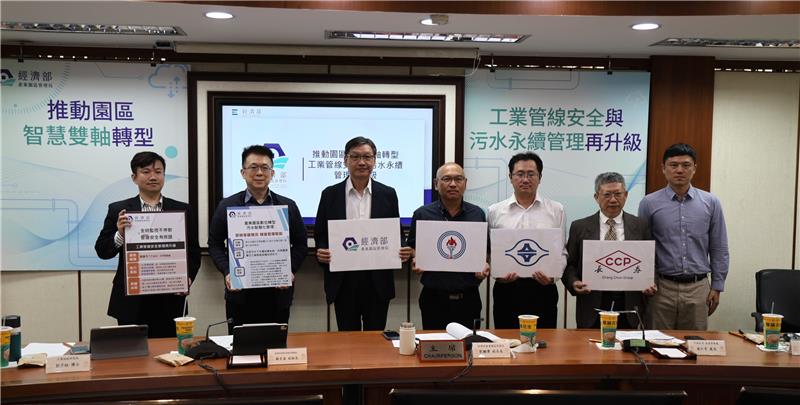
Source: Bureau of Industrial Parks, MOEA